Turmeric is a well-known plant that has long been used in food and food supplements. Its characteristic yellow-orange colour comes mainly from curcuminoids, including curcumin, the most studied compound in turmeric.
However, when choosing a turmeric-based supplement, one question often arises: are all forms of turmeric equivalent?
The answer is no. The quality of a supplement depends on several factors: the form of curcumin used, the formulation technology, the dosage per capsule, the possible presence of piperine, and the level of scientific documentation available for the ingredient.
Turmeric and curcumin: what is the difference?
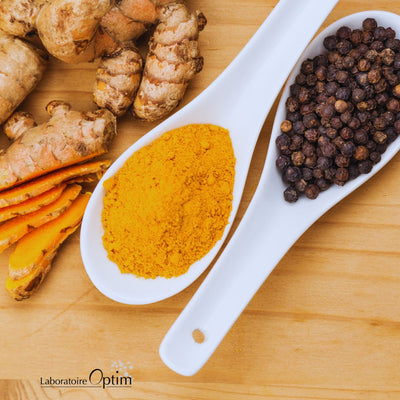
Turmeric is a plant, also known as Curcuma longa. Its root is used as a spice, particularly in Asian cuisine.
Curcumin, on the other hand, is one of the main natural compounds found in turmeric. It belongs to the curcuminoid family and is the molecule most frequently studied in scientific publications.
A food supplement may therefore contain turmeric in different forms:
- turmeric root powder;
- turmeric extract standardised in curcuminoids;
- curcumin combined with piperine;
- curcumin formulated with a lipid technology;
- curcumin in the form of micelles, phytosomes or other complexes.
These forms do not all have the same characteristics.
Why is curcumin bioavailability important?
Curcumin is naturally poorly bioavailable. This means that, in its classic form, it is difficult to disperse and absorb, and it is not always found in a form that is relevant for the body.
For this reason, many technologies have been developed to improve the bioavailability of curcumin.
These include, in particular:
- the addition of piperine, derived from black pepper;
- phospholipid complexes;
- micelles;
- nanoparticles;
- lipid technologies.
However, when talking about bioavailability, it is important not to focus solely on a single absorption figure.
Absorption does not tell the whole story
Many turmeric-based supplements highlight “better absorption”. This is a useful criterion, but it is not always enough to properly compare two forms of curcumin.
Why? Because what is measured in the blood may correspond to several different forms:
- free curcumin;
- conjugated curcumin;
- curcumin metabolites;
- total curcumin.
Total curcumin includes different forms measured in plasma. It does not always correspond exclusively to free curcumin.
Free curcumin, by contrast, refers to the unconjugated form of the molecule. This distinction is important when trying to understand the quality of a formulation.
The right question is therefore not only: “How much curcumin is absorbed?”
but rather: “In what form is curcumin actually available?”
Curcumin with piperine: why it is not always the best choice
Piperine, derived from black pepper, is often added to turmeric supplements to increase curcumin absorption.
This approach is well known, but it is based on a specific mechanism: piperine can influence certain enzymatic pathways involved in the metabolism of different substances.
For this reason, a turmeric supplement with piperine is not always the most suitable option, especially when looking for a more neutral formulation, without intentional enzymatic modulation.
The choice therefore depends on the aim of the formulation, the person’s profile and the desired level of caution.
Why choose curcumin without piperine?
Curcumin without piperine may be of interest when it is based on a specific formulation technology capable of improving bioavailability without using black pepper extract.
This is the case with lipid technologies, which aim to improve the dispersion and availability of curcumin while taking into account its fat-soluble nature.
Curcumin is indeed a molecule with a natural affinity for fats. The use of a lipid matrix may therefore be relevant in its formulation.
Longvida®: a lipid technology for curcumin
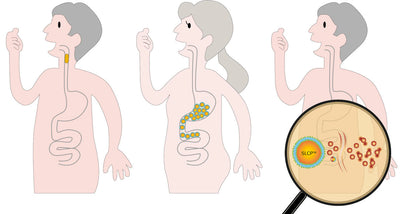
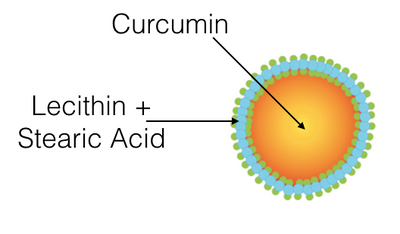
Longvida® is a form of curcumin developed with SLCP technology, which stands for Solid Lipid Curcumin Particles.
This technology is based on the integration of curcumin into a specific lipid matrix. The aim is to improve its bioavailability and support the presence of curcumin in free form.
The value of this approach is that it does not focus solely on a simple increase in total curcumin measured in plasma. Instead, it gives greater attention to the form of curcumin that is actually available.
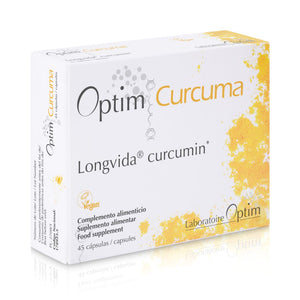
Optim Curcuma: a formula with Longvida®, without piperine
Optim Curcuma has been formulated with Longvida®, a form of curcumin using SLCP lipid technology.
Each capsule provides:
- 400 mg of Longvida®;
- a lipid-based form of curcumin;
- a formula without piperine;
- a simple and clear composition.
This choice makes it possible to offer a clearly identified curcumin-based supplement, formulated around bioavailability, free curcumin and the scientific documentation of the ingredient.
How to choose a good turmeric supplement
When choosing a turmeric-based supplement, it can be useful to consider several criteria.
1. The form used
A supplement may contain turmeric powder, a standardised extract or a specific form of curcumin. These options are not equivalent.
2. Bioavailability
As curcumin is naturally poorly bioavailable, the formulation technology is an important criterion.
3. The presence or absence of piperine
Piperine can increase absorption, but it acts on certain enzymatic pathways. Its presence should therefore be taken into account.
4. The dosage per capsule
It is important to check the actual dosage of the active ingredient or patented form used.
5. Scientific documentation
A well-documented form of curcumin makes it easier to understand its behaviour and characteristics.
6. The clarity of the composition
A simple, readable and transparent formula is always preferable.
Turmeric capsules: what should you look for?
Turmeric capsules do not differ only by their dosage. The form of curcumin used is a central criterion.
Two products may state the same amount of turmeric or curcumin, but have very different characteristics in terms of bioavailability, formulation and documentation.
This is why it is preferable to look beyond the stated dose alone.
In summary
Curcumin is naturally poorly bioavailable. For this reason, the quality of the formulation plays an important role when choosing a turmeric-based supplement.
Absorption is a useful criterion, but it is not always sufficient. It is also worth considering:
- the form of curcumin used;
- the distinction between total curcumin and free curcumin;
- the formulation technology;
- the presence or absence of piperine;
- the dosage per capsule;
- the scientific documentation;
- the clarity of the composition.
With Optim Curcuma, Laboratoire Optim has chosen Longvida®, a form of curcumin using SLCP lipid technology, without piperine, with 400 mg per capsule.
The aim is to offer a clear, high-quality and well-documented formula that goes beyond the simple idea of absorption.
Frequently asked questions about turmeric and curcumin
What is the difference between turmeric and curcumin?
Turmeric is the plant. Curcumin is one of the main natural compounds found in turmeric, belonging to the curcuminoid family.
Why is curcumin poorly bioavailable?
Curcumin is naturally difficult to disperse and absorb in its classic form. This is why different technologies have been developed to improve its bioavailability.
What is free curcumin?
Free curcumin refers to the unconjugated form of the molecule. It differs from total curcumin, which may include several metabolised forms.
Why do some turmeric supplements contain black pepper?
Black pepper contains piperine, which is often used to increase curcumin absorption. However, this approach is based on the modulation of certain enzymatic pathways.
Does Optim Curcuma contain piperine?
No. Optim Curcuma is formulated without piperine. It contains 400 mg of Longvida® per capsule.
What is Longvida®?
Longvida® is a form of curcumin developed with a lipid technology called SLCP, which stands for Solid Lipid Curcumin Particles.
How should I choose a turmeric supplement?
It is useful to consider the form of curcumin used, the formulation technology, the dosage per capsule, the presence or absence of piperine and the clarity of the composition.
Discover Optim Curcuma
Optim Curcuma is a food supplement based on Longvida®, a form of curcumin using lipid technology, without piperine.
Each capsule provides 400 mg of Longvida®.